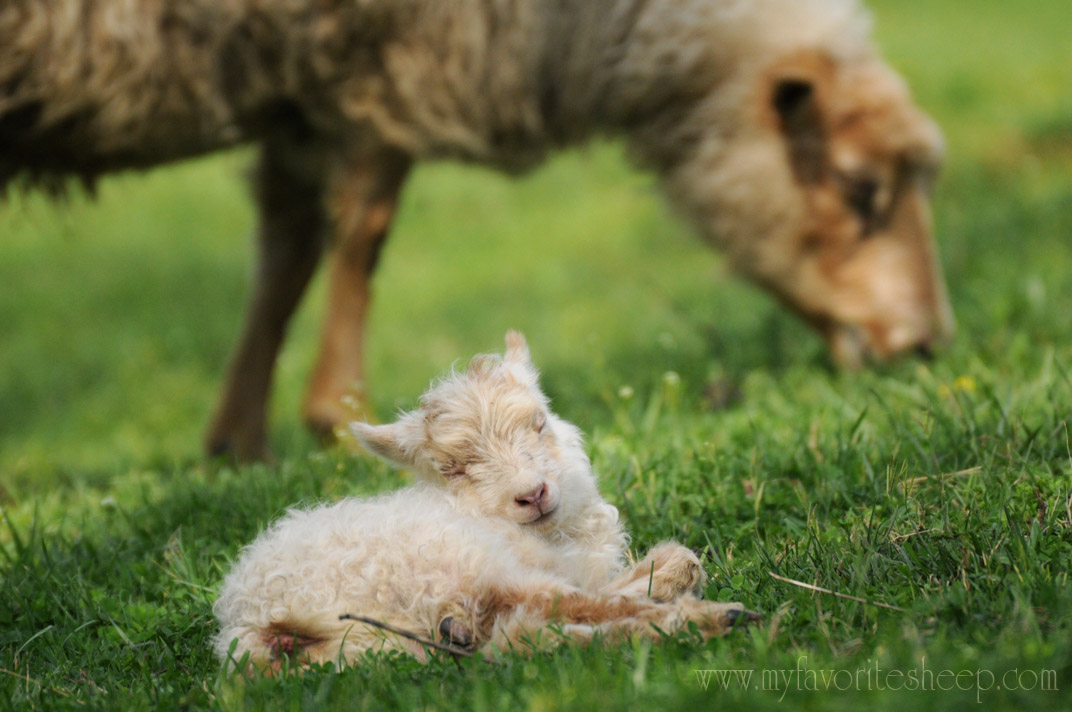
I first learned the term "skirt work" from one of my favorite blogs, Just Another Day on the Prairie. I'd not previously been aware of this...probably because cooking, cleaning, ironing, grocery shopping...ain't my strong suit. So much. Linda's got that and all the "jeans wearing" ranch work under control out there with beautiful photography as well. Around these parts I use skirt work to refer to skirting raw fleeces after shearing ;-).

While ideally it's best to skirt straight off the shearing platform, at the time, we just quickly pick up each fleece and wrap it in a breathable cotton sheet, tag it, set it to the side and bring out the next sheep to be shorn. Skirting comes later when I have time to relax and enjoy it. Guess who's next up :-).
Over the years I've set up my skirting table in several locations. In front of the
Wool House is too uneven. Behind the Wool House can be a wind tunnel.
In the barn aisle, too dark. Why I never thought to set it up behind
the barn, I have no idea.

Earlier this spring when I was trying to get Maisie acclimated to living outside, I set up the table in the little lamb pen so we could hang out together and she could have fun exploring around, eat green grass Without Eating My Flowers that were starting to come up, plus, she's great company. As were all the rest of the sheep, who were fascinated by what I was doing. I love my sheeps :-). This is a perfect spot.
Our table is simply a cattle panel with wire mesh stretched over, cable/wire tied together and then the pokey edges are covered in pipe insulation. It sits on two saw horses and there are two boards underneath that stabilize and support the length. This is a good size, not impossible for me to move by myself, stores up against a wall, out of the way. There are many different and maybe better designs out there...

So after I dump the fleece from the sheet onto the table I try to unroll/untangle it from how it was picked up. Again, ideally there is a right and wrong way to gather a fleece. However, some of ours are so big (Renny, Lila, Petunia...) that it's all we can do just to try to pick it up at all. The good folks can pick up a fleece, walk over to the skirting table and fling it, like magic, into the air and it will come down properly laid out. I've seen this on video. Yes.

This is one of those huge fleeces. I was able to pretty quickly get it laid out with the head facing us and the tail facing Maisie. The "fuzzy" fleeces hold together pretty well. The "curly" longwool fleeces don't and that's why I use the smaller wire mesh, so the individual curls don't fall through. This was the day that I took the pictures of Maisie and Betsy along the fence :-).

First off I go around the outside and pull off anything that is too dirty. This corner, tossed. I also pull off much of the britch wool, which is the coarser, longer wool found on the lower back legs/hip area. Some sheep have more britch wool than others and if it's significantly different from the rest of the fleece, I'd toss it.

Here we have dirty tips, straw and see the grayish clumps on the right of this picture? Second cuts. If you biggify I think it will show that not only are these short, but also hairy, probably from around the face or maybe the legs. That will be prickly if it gets mixed into the wool, so toss it.

These short pieces are probably not second cuts, but from shorter wool up around the face. Still, I'd toss them as they're significantly different than the rest of the fleece, the longer lock.

Hopefully if you biggify this photo, you'll see why I included it. I should have circled the area packed full of hay. This is usually just around the top of the neck (unless you are Boudreaux ;-). Sometimes I try to pick it out, but on this large fleece I just grabbed that small area and, yep, tossed it.

Now this would be a clue to me as to who this sheep was just in case her tag got misplaced. Burs. From a particularly adventurous sheep ;-). I used to think burs meant a fleece was ruined. I've since learned that while they are painful to pick out at this point, once the fleece has started the wash process they slide right out. I wouldn't sell a fleece like this, but if you ever run across burs, just wait to remove them until the wool is wet.

Now, once most of the bad stuff has been removed I fold one side over the middle.

Oops, more second cuts. With larger holes in your skirting table, these second cuts tend to go ahead and fall through. With my small holes, they don't as much and I just grab them as I see them. You can also shake the fleece to encourage them to fall out, but I don't do much of that until I get ready to wash as I like being able to roll the fleece up for storage and every time I shake one, it's never quite the same.

So, fold one side over, then the other over the top.

Start rolling from the tail to the head.

And stuff it in a bag.
Yep, that's Blossom! Her fleece has since been washed and already back from the mill - beautiful bright white sproingy roving. I'm going to keep at least half of it since it's her "baby locks", but might sell the other half at the Kentucky Sheep and Fiber Festival next week. I'm pretty happy with my fleeces and roving this year and hoping anyone who's coming out will be as well :-).
Ack!!! One thing I just realized I didn't include here is testing for fleece soundness. This is important for a handspinning fleece. You'll want to make sure the structure of the fleece itself is strong with no weak spots due to stress from illness, lambing... The other spot to check is the tips. Especially on lamb fleeces, the tips can be fragile and that could cause trouble during carding. This is probably a whole 'nuther post and I've got to get back to "blue jean" work...so "to be continued".